


Rakuto, Kii Peninsula
Rakuto, Kii Peninsula
Couldn't load pickup availability
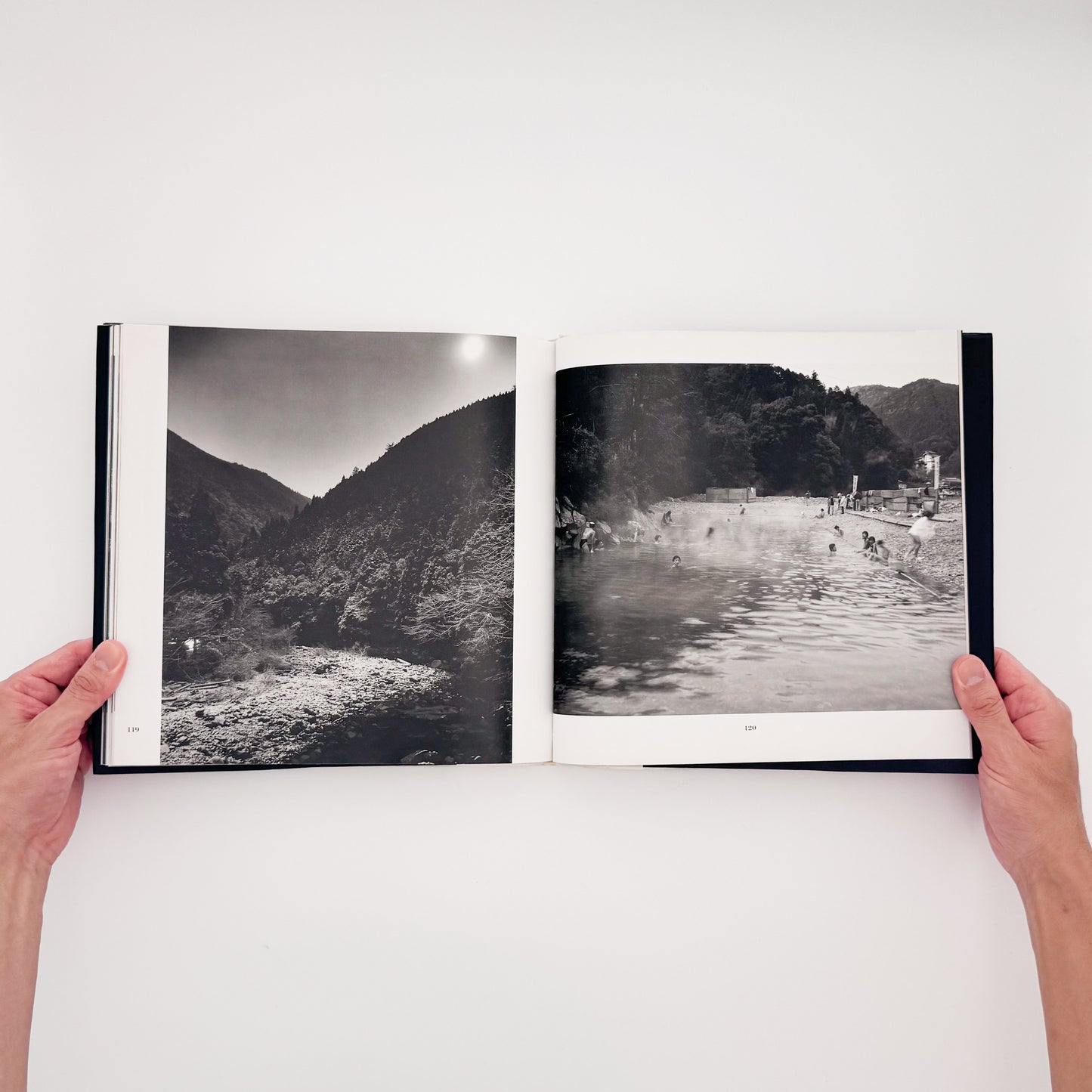
A photobook by Shunji Dodo. This single volume contains photographs taken with an 8x10 inch large format camera over approximately four years, from the autumn of 1990, across the Kii Peninsula, spanning Nara, Wakayama, and Mie prefectures.
After moving from Osaka to Kitakatsuragi-gun, Nara Prefecture, Dodo repeatedly visited Katsuragi, Yoshino, Totsukawa, Hongu, Shingu, Owase, Ise, and other areas, confronting mountains, rivers, the sea, villages, festivals, and the people living there. This work aimed to capture the light, wind, and the smell of water he felt when enveloped by the nature of the Kii Peninsula, as well as the sensation of blood flowing through his body, and to fix these real feelings as photographs.
He used an 8x10 inch wooden field camera for the shoots. Initially, he focused on landscapes, but an encounter with boys in Tenkawa Village shifted Dodo's interest more clearly towards people. With the desire to photograph "you, who are there, just as you are," he approached people living rooted in the land, continuing to photograph by alternating between landscapes and people.
This book does not only depict the expansive mountains, rivers, and sea of Kii. It also shows the bodies and expressions of the people who work, play, gather at festivals, and continue their lives in that land. Rather than separating nature and humanity, the collection of photographs, which captures the body and the natural features as a single continuous entity, evokes the passage of time in the land of the Kii Peninsula and the presence of people's lives.
In 1996, it received the Photographic Society of Japan Annual Award. It is an important work for understanding Shunji Dodo's creative process, leading later to "Sennen Rakudo," which also photographed the Kii Peninsula.
[Title] Rakudo Kii Hanto (Paradise Kii Peninsula)
[Publisher] Brain Center
[Publication Date] November 30, 1995 (First Edition, First Printing)
[Page Count] 144 pages
[Size] Approximately 268 x 265 x 17mm / 990g
[Format] Hardcover
[Language] Japanese
[Title Reading] RAKUDO KII HANTO
[Author/Editor] Shunji Dodo/Author, Toshimasa Dodo/Cover Design, Tadayoshi Moriya/Printing Direction, Toshio Imai/Platemaking
[Printing] Mitsumura Printing Co., Ltd./Printing and Binding
[ISBN] 9784833905251
[Condition] Used [4] Good to Fair (Cover: minor damage and scuffs on top/bottom edges, Book body: minor foxing on all three edges, tape removal damage on front endpaper)
[Accessories] -
[Featured In] -
[Related Exhibitions] "Rakudo Kii Hanto" (Shinjuku, Osaka, Sapporo Konica Plaza, 1995-1996)
Shunji Dodo (born 1947)
Born in Osaka Prefecture. Photographer, photography educator.
Graduated from the Department of Photography, Faculty of Art, Kyushu Sangyo University. Became a teacher at Tokyo College of Photography in 1970, and at Osaka School of Photography (now Visual Arts College Osaka) in 1972, where he was appointed principal in 1998. In 2015, he became director of the Irie Taikichi Memorial Museum of Photography, Nara City.
He has photographed lands and people across various regions of Japan, including Osaka, the Kii Peninsula, and the Sea of Japan, over long periods. Using large format cameras, he creates works themed around local features, life, the body, and memory. In addition to being a photographer, he has been involved in photography education for many years, nurturing many aspiring photographers.
Major works include "Shinsekai Mukashi mo Ima mo," "Horizon," "Rakudo Kii Hanto," "Sennen Rakudo," "Sharasoju," "Hana Haha," "Osaka," "Harukanaru Chihei 1968-1977," "Nihonkai," and "Sora Hoteru no Machi."
Major awards include the Photographic Society of Japan Annual Award (1996), the 24th Ina Nobuo Award (1999), the Photographic Art Society of Japan Award (2007), the 23rd Photo Society Award (2011), and the 27th Higashikawa Award Hidano Kazue Award (2011).
Major collections include the Irie Taikichi Memorial Museum of Photography, Nara City.
< Related Figures >
Daido Moriyama, Shomei Tomatsu, Masahisa Fukase, Nobuyoshi Araki, Arata Dodo


You may also like
-
Portrait from Tibet
Vendor:有元伸也 / ARIMOTO ShinyaRegular price ¥5,500Regular price -
Risaku Suzuki: Between the Sea and the Mountain – Kumano
Vendor:鈴木理策 / SUZUKI RisakuRegular price ¥17,500Regular price -
Risaku Suzuki KUMANO
Vendor:鈴木理策 / SUZUKI RisakuRegular price ¥8,800Regular price


